What Is the Japanese Language Proficiency Test (JLPT)?
February 3, 2026
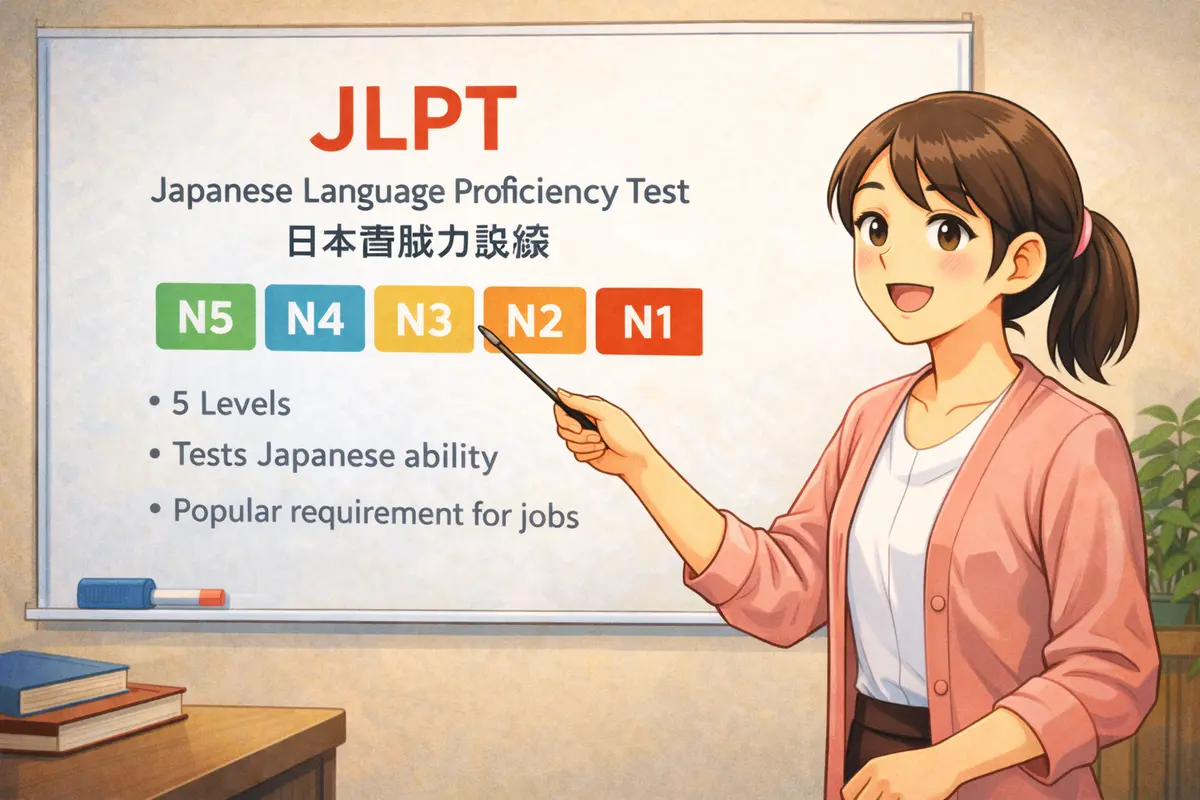
If you've been studying Japanese for any amount of time, chances are you've come across the term JLPT-the Japanese Language Proficiency Test. It's the most widely recognized exam for measuring Japanese ability among non-native speakers, and it often shows up in job listings, university requirements, and study plans.
But what exactly is the JLPT? Who is it for? And is it something you actually need to take?
This guide breaks down what the JLPT is, why people take it, how it works, and what you can realistically expect from the experience.
What Is the JLPT?
The Japanese Language Proficiency Test (JLPT) is a standardized, paper-based exam that evaluates your ability to understand Japanese through reading and listening. It does not test speaking or writing.
The test is offered at five levels, from beginner to advanced:
You choose which level to take when you apply. There's no requirement to pass lower levels before attempting a higher one.
Since its introduction in the 1980s-and a major revision in 2010-the JLPT has become the most commonly used benchmark for Japanese proficiency worldwide, with hundreds of thousands of test-takers every year.
Why Do People Take the JLPT?
People sign up for the JLPT for very different reasons, depending on where they live and what they want to do with Japanese.
In Japan
Inside Japan, the JLPT is often tied to practical needs:
In reality, employers often care more about how well you perform in interviews than the certificate itself-but having JLPT credentials can get your foot in the door.
Outside Japan
Outside Japan, the JLPT is commonly used as:
Even if you don't need it immediately, preparing for the JLPT can give structure to your studies and a clear sense of direction.
That said, the JLPT is optional. It's a useful tool-but not the only way to measure real-world Japanese ability.
How Do You Take the JLPT?
The JLPT is offered:
The test is not online. You must take it in person at an official testing site.
Registration happens online and is brief, usually only a few weeks long. Miss the window, and you'll have to wait until the next test cycle.
Fees vary by country, but typically range from:
There are no refunds if you miss the test, so it's worth double-checking your schedule before signing up.
What Is the Test Like?
Expect a highly structured, no-nonsense testing environment.
You'll be seated in a room with other examinees, given strict instructions, and timed carefully. Anti-cheating rules are enforced, which can include restrictions on stationery, clothing with Japanese text, and labeled items.
You'll need:
The test experience itself is straightforward-but mentally demanding, especially at higher levels.
JLPT Levels: What Can You Do at Each One?
Here's a practical overview of what each level roughly represents:
N5
N4
N3
N2
N1
Choosing a level depends on your goals. You can retake the same level multiple times, skip levels, or start conservatively and work upward.
What Does the JLPT Test?
The JLPT evaluates three main areas:
Language Knowledge
Reading
Listening
There are no speaking or writing sections, which surprises many learners.
Higher levels combine vocabulary, grammar, and reading into one long section, making time management especially important.
Time Limits and Endurance
Depending on the level, the test lasts from about 1 hour to nearly 3 hours.
Listening sections are strict-no replays, no pauses. Fatigue is a real factor, especially if listening comes after a long reading section.
Good sleep, steady focus, and pacing matter almost as much as language knowledge.
Scoring and Results
To pass, you must:
The JLPT uses scaled scoring, meaning your final score isn't a simple count of correct answers. Instead, question difficulty and answer patterns are factored in.
There's no penalty for wrong answers, so always fill everything in.
Results are released about 2-3 months later, online first, followed by a mailed score report. If you pass, you'll also receive an official certificate.
Should You Take the JLPT?
The JLPT is useful if you:
But it's not mandatory for everyone. Fluency in real life involves speaking, reacting, and thinking on your feet-skills the JLPT doesn't directly measure.
That's why many learners combine JLPT study with active usage: conversations, listening practice, and realistic scenarios. Tools like Chatty Sensei, for example, help bridge that gap by letting learners practice Japanese in real-life situations while reinforcing vocabulary and grammar that naturally align with JLPT levels.
Final Thoughts
Whether you're aiming for N5 or N1-or just curious about where you stand-the JLPT can be a valuable checkpoint on your Japanese journey.
Passing feels great. Failing still teaches you something. And simply showing up means you're doing the work.
No matter your score, the real progress comes from consistently engaging with Japanese in ways that keep you motivated, challenged, and moving forward.